Two times the established team leader saw off a new challenge as Antonelli takes the fight to Russell
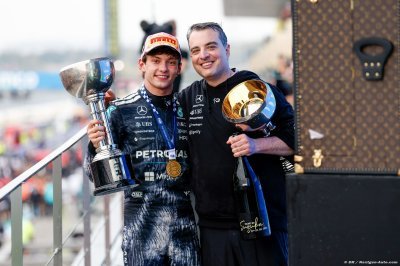
Picture the Suzuka podium. Third race of the 2026 season, and standing on the top step — champagne-drenched, grinning the grin of a man who hasn’t yet learned to be afraid of the moment — is Kimi Antonelli. Nineteen years old. Two wins from the last two races. The youngest championship leader in Formula 1 history.
George Russell is one step below him.
Antonelli Takes the Fight to Russell
Russell arrived in Melbourne for the 2026 season opener as the pre-season betting favorite to claim the title. He duly won that Albert Park opener, and he did so with the composure of someone finally driving a car built around him. He was supposed to be the story of this year. Then Antonelli won in China. Then the Italian teenager won again in Japan. And Russell stood looking up at that Suzuka podium after finishing in fourth place and surrendering the championship lead. Online betting sites have lost some faith as well.
Websites offering sports betting in Canada made Russell a 1/3 favorite to claim the title after Australia. Now, he remains the favorite, but he’s out at even money, with Antonelli right behind him at 11/10. History, though, offers him something.
Plenty of times before, an established team leader absorbed precisely this kind of shock and still prevailed. The keyword is absorbed. None of them made it look easy. Here are two such occasions.
Civil War at McLaren
Lando Norris began the 2025 season as the closest thing Formula 1 had to a coronation in waiting. He mounted a minor championship challenge in 2024, but was unable to convert his opportunities, mistakes that Max Verstappen and Red Bull simply don’t make. The following year, however, McLaren had built a rocket ship, the fastest car on the grid by some distance, and Norris was the talisman.
His younger teammate Oscar Piastri was excellent, obviously — brilliant, even — but he was 24 years old and entering only his third season. The hierarchy felt settled, especially with Norris having four more years of experience. Turns out, it wasn’t.
Piastri won five times in the first half of the year, and the paddock started asking questions McLaren hadn’t wanted asked. The team did what teams always do when the politics become uncomfortable: they deployed the radio. In Austria, they’d been swapping positions back and forth all race, Norris’s engineer feeding him pace targets, Piastri’s engineer doing the same — two men in the same garage, on the same tire strategy, trying to serve two masters simultaneously while pretending it wasn’t happening. The relationship was becoming something the press conference smiles couldn’t entirely conceal.
Then came Montreal.
Lap 67 of 70. Norris slipstreamed his teammate down the pit straight and drove directly into the back of Piastri’s McLaren, broke his own suspension on the pit wall, and retired from the race. Twenty-two points transferred in a single moment of miscalculation. "McLaren is my family," Norris said afterwards, voice stripped down to something genuinely raw. "When I make a fool of myself like I did today, I have a lot of regret."
Singapore delivered another collision, another points swing, and another stern conversation with McLaren management. But when the season reached its apex, Norris showed his clash. He picked up back-to-back wins in Mexico and Brazil, which recaptured the championship lead. Piastri was collapsing in the meantime, retiring in Azerbaijan before embarking on a streak of five races without a podium, his worst run of the season.
Norris would go on to claim his maiden title in Abu Dhabi, securing the third-place finish he needed to claim the crown and ultimately see off the challenge of Piastri - and the relentless Max Verstappen. Can he do the same in a slower car in 2026? Time will tell.
Red Bull’s Graveyard
The Red Bull garage over the last decade tells a different story. A more brutal one. Daniel Ricciardo came closest to taking the fight to the superstar Max Verstappen. He was the established driver when the Dutch sensation made the step up from Toro Rosso in 2016, and for three seasons, he fought with genuine distinction — outqualifying him 11-6 in his maiden season, accumulating five wins and 22 podiums across the partnership, the only teammate Verstappen has ever faced who could claim to have competed over multiple campaigns.
Their 2018 Azerbaijan collision was spectacular and costly, and settled nothing. But Ricciardo read the room before the room could read him. Red Bull was being rebuilt around Verstappen; he sensed it before the confirmation arrived and chose to leave rather than spend his prime playing supporting act to someone six years younger. That decision — the voluntary exit of the one man who’d actually competed — tells you everything about how immovable the hierarchy had become.
What followed was a procession. Pierre Gasly: promoted, demoted back to Toro Rosso inside 12 races. Alexander Albon: fared marginally better, quietly dropped at year’s end. Then Sergio Pérez — respected across the entire paddock, a proven race winner, a man with genuine experience and four years of committed service, five wins and 24 podiums. He deteriorated anyway.
When Red Bull dropped him, there was no drama, just the quiet closing of a door on someone who had given everything and still found it insufficient. Lawson lasted two races at the start of 2025. Yuki Tsunoda saw out the rest of the season, but he, too, is now gone. Will Isack Hadjar fare any better in 2026? If his start to the season is anything to go by, he just might.