Three Times a Team’s ‘Second’ Driver Battled for the Championship as Antonelli Upstages Russell in 2026
George Russell arrived in 2026 as the man in control. Three seasons alongside Lewis Hamilton had taught him how to lead a Mercedes garage without a seven-time champion doing the talking for him, and when the GOAT left for Ferrari, G-Russ inherited the team leader’s chair outright. Paired with a teenage rookie in Kimi Antonelli for his first full campaign throughout 2025, Russell was the main man by every reasonable measure: the senior driver, the known quantity, the man Mercedes had built its project around.
For much of last season, that narrative proved accurate. Antonelli struggled, while Russell was as consistent as ever. Online betting sites then made the Brit the overwhelming favourite to win the World Championship heading into 2026, and those predictions seemed accurate when Russell won the curtain-raiser in Melbourne. Since then, however, it has been one-way traffic, with young Antonelli dishing out the beating on a weekly basis.
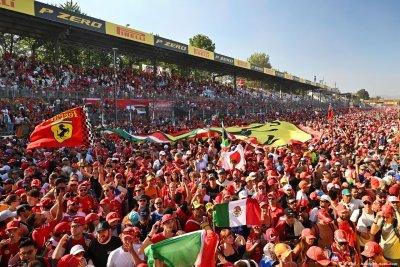
Antonelli’s Stunning Monza Triumph
Heading into the recent Italian Grand Prix, it was the Italian who headed the championship standings by some distance, winning six Grand Prix compared to Russell’s paltry two. Then, to ram home his dominant advantage, Antonelli won his home race from 19th on the grid.
A 30-place grid penalty for an unscheduled engine change should have ended his Italian Grand Prix before it started; instead, he sliced through the field at Monza, caught Russell in the closing laps, and passed him at the second time of asking to become the first Italian to win his home race in 60 years. It was his seventh win of the season, and it stretched his championship lead over his own teammate to 66 points with nine races left, and one look at those same betting sites shows the monumental shift in power within the Mercedes garage.
The popular 7signs online sportsbook listed Russell as the even-money championship favourite after Melbourne. Now, he’s out at 15/1, while Antonelli is installed as the mightily short 3/25 favourite to become the youngest world champion in F1 history.
What does it say about how completely the pecking order flipped that a second-year youngster pencilled in as Mercedes’ clear No. 2 now leads the man he was meant to support by more than two race wins’ worth of points? Antonelli’s 2026 isn’t unprecedented, though. F1 has form for this, and three earlier seasons show just how differently that story can end.
Felipe Massa - 2008
Felipe Massa entered 2008 as Ferrari’s dutiful support act, having shuffled aside for Kimi Räikkönen’s title push a year earlier, while Lewis Hamilton, fresh off a rookie campaign that fell one point short (more on that shortly), was tipped as the man to beat.
Massa’s season started poorly, with retirements in Australia and Malaysia while defending champion Räikkönen and Hamilton traded blows at the front. But Ferrari’s pecking order curdled as the year wore on. By the Chinese Grand Prix, the penultimate round, Räikkönen had fallen out of contention entirely, and the team’s full support shifted to Massa.
Is there a cleaner illustration of a supposed wingman seizing his moment than what followed at Interlagos? Massa dominated his rain-hit home finale from pole, and for thirty surreal seconds, with his own team and family celebrating in the garage, he believed he’d won the title. Hamilton, meanwhile, had slipped outside the top-five spot that he had desperately clung on to for much of the race, and all hope seemed lost. Then, he scythed past Timo Glock’s fading Toyota at the final corner of the final lap of the final race of the season to snatch the fifth place he required to claim his maiden title.
The margin was one point, 98 to 97, and it made Hamilton the sport’s youngest champion. Massa never won another Grand Prix ever again.
Lewis Hamilton - 2007
Fernando Alonso arrived at McLaren in the winter of 2007 after claiming back-to-back world championships with Renault and expected the garage to bend around him, the first man since Fangio to try defending a title at a new team. Hamilton was 22, a debutant who was meant to spend the year taking notes. Instead, he podiumed in Melbourne and was leading the championship within weeks - and the mood inside McLaren quickly shifted.
There were accusations over team orders in Monaco, engineers picking their radio words with obvious care, and then Hungary, where a pit-lane blocking incident cost Alonso a grid penalty and a brutal deduction of constructors’ points. Imagine being the driver at the centre of that - technically a teammate, functionally a target.
Arriving in Brazil for the final race of the season with a four-point lead over Alonso and seven over Räikkönen, Hamilton’s title slipped away almost immediately: an opening-lap tangle dropped him to eighth, then a gearbox glitch on lap seven sent him plummeting to 18th. He clawed back to seventh, but it wasn’t enough. Räikkönen won the race and the title on 110 points; Hamilton and Alonso tied on 109, with McLaren’s civil war ultimately costing both men the crown.
Kimi Räikkönen - 2003
A 22-year-old Kimi Räikkönen arrived to replace fellow Finn and former two-time world champion Mika Häkkinen at McLaren in 2002 after just 17 races in Formula One. He was very much considered an up-and-coming prospect who was brought in to support David Coulthard, and in his first season with the team, that proved true to form as the experienced Scot regularly outperformed his new young teammate.
In 2003, though, something changed. Coulthard watched his young teammate’s sector times quietly, unglamorously overtake his own, race by race, without a crash or a controversy to mark it. Räikkönen finished second in Australia, won in Malaysia, and just kept collecting podiums under a new points system built for consistency. Nobody inside McLaren needed to say the order had flipped. The timing sheets said it for them.
Michael Schumacher led the Iceman by only two points after a lapped eighth in Hungary, before Ferrari’s form recovered and back-to-back wins in Italy and the US ensured he carried a nine-point cushion into Suzuka. Schumi’s eighth-place finish there - one solitary point - was enough to clinch a sixth title, 93 to 91. Räikkönen was left as runner-up, 40 points clear of the man who’d been the team’s undisputed leader when the year began.