Red Bull still fighting FIA over controversial engine ruling
"It’s still a bit early for congratulations"
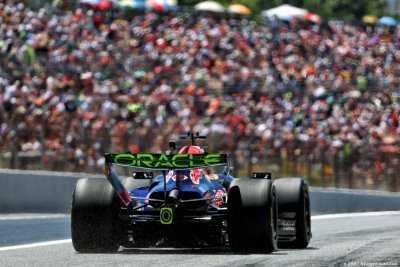
Red Bull is continuing to challenge the FIA’s controversial ADUO engine assessment, amid concerns the ruling could have major consequences for the next three Formula 1 seasons.
The governing body’s preliminary analysis identified Red Bull-Ford as the benchmark combustion engine supplier for 2026.
Ironically, that means Red Bull is currently the only manufacturer unable to access the performance upgrade concessions available under the ADUO system.
Mercedes, Ferrari, Audi and Honda all stand to benefit.
When Viaplay jokingly congratulated Red Bull team boss Laurent Mekies on having the best engine in Formula 1, the Frenchman was not celebrating.
"It’s still a bit early for congratulations," Mekies smiled. "We have received some information subject to change from the FIA."
He confirmed that Red Bull has formally requested clarification and a review of the calculations. "As you can imagine, we have very detailed discussions with them to make sure their analysis is correct," said Mekies.
"It is not appropriate if I respond to this further before the FIA shares the conclusions."
The stakes are high because the ADUO concessions extend beyond this season.
"This applies not only to 2026, but also to 2027 and even in certain ways to 2028," said the Frenchman.
Mekies added: "I think it is very important for the sport that the picture outlined is also correct."
The FIA has repeatedly stressed that the system is based on objective measurements gathered from standardised torque sensors fitted to every car.
Mercedes boss Toto Wolff defended the process.
"In my opinion, when you speak to Nikolas, it’s data that they have measured and collected," he said, referring to FIA single-seater director Nikolas Tombazis.
"There’s no political background, there is no favours, but it’s the outcome of their analysis of their torque sensors and the way it’s being done."
Audi chief Mattia Binotto also backed the FIA’s methodology, although he suggested the regulations themselves may need refinement.
"I think there is no doubt on the assessment," said Binotto. "We’ve got proper sensors on the car to measure the delta power."
However, he questioned whether pure power output should remain the basis for future ADUO calculations.
"Maybe we should do something very similar to the chassis, where you base it on standings of the previous seasons," Binotto suggested. "If convergence is the purpose, maybe that’s the most straightforward."
Tombazis explained that the system was specifically designed to prevent manufacturers from becoming permanently uncompetitive.
"There was a concern that if you started behind, you could be almost condemned to permanent poverty," he told Soy Motor.
"And that permanent poverty would lead to these OEMs leaving the sport."
He added that ADUO deliberately focuses only on the combustion engine element of the power unit.
"The reason for that is because there was a feeling that the electric side would be the battleground," said Tombazis. "The feeling was that the thermal side wouldn’t be such a big battle, so if you were behind, you should have the time, money, and resources to catch up."
However, he admitted the FIA remains open to revisiting the rules.
"We want to see what the best way to do it is for the sport," Tombazis said. "Whether it will be exactly the same or not, that’s something that needs to be discussed."